You’ve moved into your new flat. The keys are in your hand; the walls are freshly painted - and then comes the question nobody warns you about: where exactly does the sofa go?
In small Indian apartments, furniture placement isn’t just about aesthetics - it’s about survival. One wrong move - a sofa that’s 10 cm too wide or a coffee table placed at the wrong angle - and suddenly your living room feels like an obstacle course. You are squeezing past the TV unit every morning, your guests are sitting with their knees almost touching the opposite wall, and the room that looked spacious in the brochure now feels like a storage unit.
Here’s the truth: the size of your flat isn’t the problem - the layout is.
Most 1BHK and compact 2BHK living rooms in Indian cities measure between 100 and 180 sq ft. That is not a lot of space, but it is more than enough if you know how to use it. The right furniture layout can make a 120 sq ft room feel open, comfortable, and designed. The wrong layout can make even a 200 sq ft room feel cramped.
This guide covers 5 furniture layouts that are specifically designed for small Indian flats. Each layout comes with exact measurements, what furniture you need, what to avoid, and which room shapes it works best for. By the end of this post, you will know exactly how to set up your living room - without wasting money or floor space.
Why Furniture Layout Matters More Than Room Size
Before diving into the layouts, understand one thing: traffic flow is the foundation of every good layout.
Traffic flow is the invisible path people take through your living room - from the entrance to the balcony, from the sofa to the kitchen, and from the TV to the main door. If furniture blocks these paths, the room feels tight and frustrating no matter how beautiful it looks. If the paths are clear and natural, the room feels spacious even if it is small.
The second principle is the focal point rule. Every living room needs one anchor - usually the TV, a window with a view, or a statement wall. All your furniture should face or respond to this focal point. When furniture faces multiple directions with no clear anchor, the room looks chaotic and feels uncomfortable.
Third principle - the two-thirds rule. Your sofa should not occupy more than two-thirds of the wall it sits against. If your wall is 12 feet wide, your sofa should be no wider than 8 feet. This simple rule prevents the suffocating, over-furnished look that’s extremely common in small Indian flats.
Keep these three principles in mind as you go through the five layouts below.
Layout 1 - The Classic Wall-Anchor Setup
Best for: Rectangular rooms, 10×12 ft to 12×14 ft
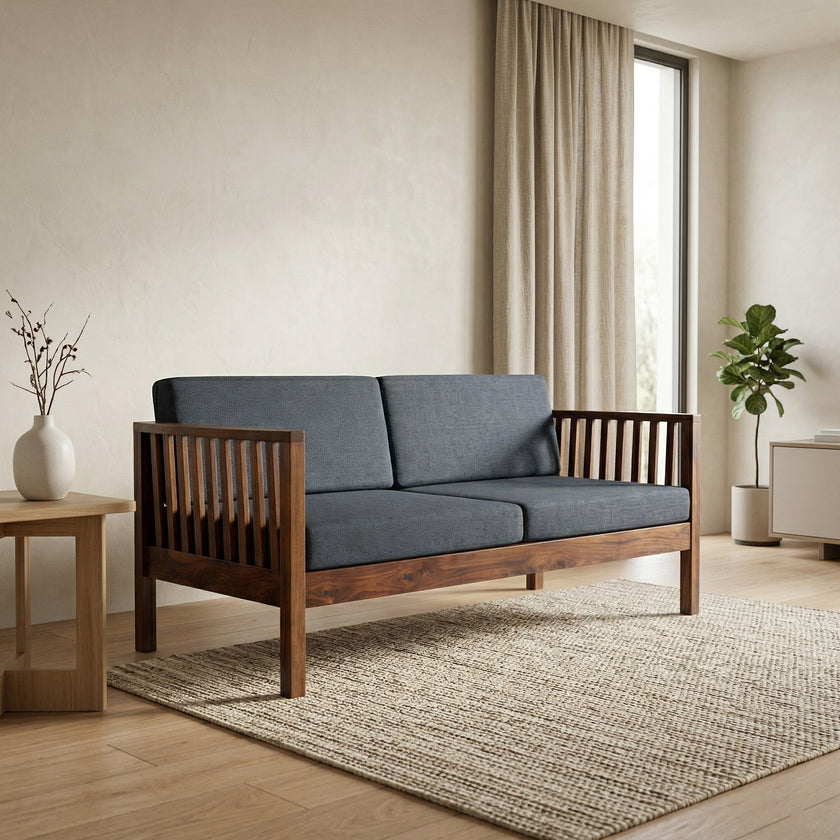
Works with 2- seater sofa + coffee table + TV unit
Difficulty: Beginner - easiest layout to execute
This is the most common layout in Indian homes - and when done correctly, it is also one of the most effective. The sofa sits against the longest wall, directly facing the TV unit on the opposite wall, with the coffee table centered between them
Why it works in small flats:
Anchoring the sofa to the wall immediately frees up the center of the room. The walking path from the entrance to the balcony or bedroom stays completely clear. There is no furniture in the way, no squeezing past anything. The room feels longer and more open than it actually is.
Exact measurements to follow:
|
Element
|
Recommended Measurement
|
|
Gap between sofa and TV wall
|
Minimum 6 feet (180 cm)
|
|
Gap between sofa and coffee table
|
35–45 cm
|
|
Gap between coffee table and TV unit
|
Minimum 60 cm
|
|
Side clearance (sofa to side wall)
|
Minimum 45 cm
|
What furniture you need:
-
A 2-seater sofa (180–210 cm wide) - solid wood frame preferred for durability
-
A rectangular coffee table (90–110 cm long)
-
A TV unit or low console (not wider than the sofa)
One mistake to avoid: Do not push the sofa completely flush against the wall. Leave at least 5–10 cm of breathing room behind it. It sounds unnecessary, but it creates visual depth and allows air to circulate. Rooms with sofas glued to the wall look stiff and over-packed.
Induscraft tip: A solid sheesham wood sofa in this layout looks best when the TV unit is also in a matching wood finish. The consistency ties the room together without needing any extra decor.
Layout 2 - The L-Shape Corner Layout
Best for: Square rooms, 12×12 ft to 14×14 ft
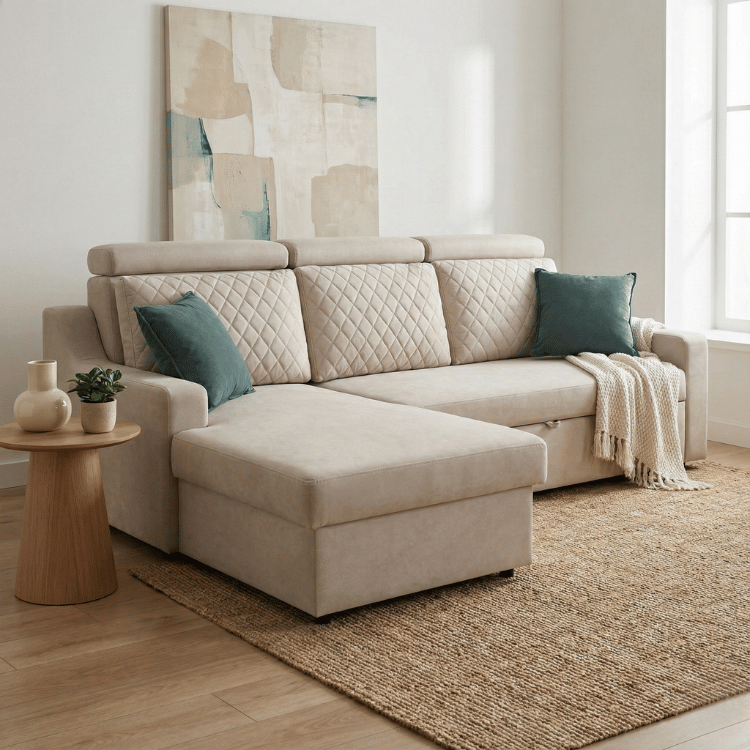
Works with: L-shape sofa + small coffee table or ottoman
Difficulty: Intermediate - requires precise measurement before buying
If you have a square room, a 3-seater sofa against one wall will always leave the adjacent walls feeling empty and wasted. This is where an L-shape sofa completely transforms the room.
An L-shaped sofa placed in the corner completely transforms the room - it maximizes seating, clearly defines the living zone, and opens up the center. The result is a living room that feels both larger and more purposeful.
Why it works in small flats:
Square rooms have no obvious "longer wall" to anchor furniture against. An L-shape sofa solves this by using two walls simultaneously - the corner becomes the anchor point instead of a single wall. This is significantly more efficient use of space than a standard sofa setup.
Exact measurements to follow:
|
Element
|
Recommended Measurement
|
|
L-shape long arm
|
220–260 cm
|
|
L-shape short arm
|
150–180 cm
|
|
Gap between sofa and coffee table
|
35–40 cm
|
|
Center of room (keep clear)
|
Minimum 5×5 ft zone
|
What furniture you need:
-
A compact L-shape sofa (long arm no more than 260 cm for a 12×12 room)
-
A round or square coffee table (round works better - it allows easier movement around it)
-
Skip the additional accent chairs - the L-shape provides enough seating
One mistake to avoid: Do not buy an L-shape sofa that is too large for the room. The most common error is ordering a sofa where the long arm exceeds 280 cm in a room that is only 12 feet wide. Always measure twice before ordering. The sofa should leave at least 3 feet of clear walkway on both open sides.
Induscraft tip: With an L-shape layout, skip the TV unit entirely if possible - mount the TV on the wall instead. Wall-mounted TVs save 40–50 cm of floor depth and make the room feel significantly more open.
Layout 3 The Floating Sofa Layout
Best for: Slightly larger rooms, 12×15 ft and above
Works with 3-seater sofa + accent chair + coffee table
Difficulty: Intermediate - counterintuitive but highly effective
Most Indian homeowners push all furniture against walls instinctively. This feels logical - surely keeping furniture out of the center makes the room feel bigger. Actually, the opposite is true.
The floating sofa layout pulls the sofa away from the wall by 30–50 cm and brings it slightly toward the center of the room. This small shift creates visual depth behind the sofa, makes the ceiling feel higher, and - paradoxically - makes the room feel more spacious. than a wall-anchored setup.
Why it works in small flats:
When all furniture is pushed to the walls, the center of the room becomes a dead, empty zone with no purpose. It looks like an unfinished room. Floating the sofa forward brings the furniture into the room and creates a defined, cozy seating zone. The space behind the sofa becomes a natural walkway rather than empty dead space.
Exact measurements to follow:
|
Element
|
Recommended Measurement
|
|
Gap between sofa back and wall
|
30–50 cm
|
|
Gap between sofa and coffee table
|
35–45 cm
|
|
Gap between coffee table and TV wall
|
Minimum 90 cm
|
|
Space on either side of sofa
|
Minimum 60 cm
|
What furniture you need:
-
A 3-seater sofa (solid wood frame - a floating sofa is more visible from all angles, so quality matters more here)
-
One accent chair placed at a slight angle beside the sofa
-
A rectangular or round coffee table centered in front of the sofa
-
A medium area rug to anchor the seating zone
One mistake to avoid: A floating sofa without a rug looks disconnected and random. The rug is what makes this layout feel intentional. At minimum, the front legs of your sofa and the accent chair should rest on the rug. This grounds the furniture and defines the zone clearly.
Induscraft tip: This layout showcases solid wood furniture beautifully. When the sofa floats in the room, you can see the craftsmanship of the frame from multiple angles - unlike a wall-anchored sofa where the back is hidden. A sheesham wood sofa with visible joinery and carved details earns its visual presence in a floating layout.
Layout 4 The Compact TV-Facing Setup
Best for: Very small rooms, under 10×12 ft; studio flats and 1BHK
Works with 2-seater sofa or compact 3-seater + minimal side table
Difficulty: Beginner - minimal furniture, maximum clarity
When your room is genuinely small - under 120 sq ft - the rules change. In very small spaces, the goal It’s not about creating a beautiful layout - it’s about creating a functional one that doesn’t feel claustrophobic.
The compact TV-facing setup strips everything back to the essentials: one sofa, one TV unit or wall-mounted screen, and nothing else on the floor except possibly a small side table. No coffee table, no accent chair, no rugs that overflow the boundary. Clean, simple, functional.
Why it works in small flats:
In rooms under 10×12 ft, a coffee table takes up floor space that is genuinely needed as walking space. Removing the coffee table and replacing it with a small side table beside the sofa frees up 60–90 cm of clearance between the sofa and the TV wall - enough to make the room feel breathable instead of packed.
Exact measurements to follow:
|
Element
|
Recommended Measurement
|
|
Sofa width
|
Maximum 180 cm (2-seater or compact 3-seater)
|
|
Gap between sofa and TV wall
|
Minimum 5 feet (150 cm)
|
|
TV unit depth
|
Maximum 35 cm — or mount on wall
|
|
Side table
|
40–50 cm wide, maximum
|
What furniture you need:
-
A compact 2-seater or short 3-seater sofa (maximum 180 cm wide)
-
A wall-mounted TV (strongly recommended over a TV unit to save floor depth)
-
One small side table or a pair of nesting tables beside the sofa
-
No coffee table - replace with a small pouf or ottoman that can be moved easily
One mistake to avoid: In a compact room, do not try to fit in "just one more piece." Every extra item - an accent chair, a decorative console, a second side table - steals floor space and traffic flow. Restraint is the actual design skill in small rooms.
Induscraft tip: For very small rooms, a 2-seater sofa with solid wood legs is ideal. Raised legs create visual space underneath the sofa, which makes the floor feel continuous and the room feel larger. A sofa that sits flush to the ground in a small room visually "blocks" the floor and makes the space feel heavy.
Layout 5 - The Open-Plan Dual Zone Layout
Best for: Flats where the living room and dining area share one open space
Works with 3-seater sofa + small dining table with chairs
Difficulty: Advanced - requires careful zoning and consistent furniture style
Many modern Indian apartments - particularly 1BHKs and compact 2BHKs - have an open-plan layout where the living area and dining area exist in the same room with no wall separating them. This is efficient from a construction standpoint but challenging from a design standpoint. How do you make one room feel like two distinct spaces?
The dual zone layout uses furniture placement - not walls - to create two separate zones in one open room. The sofa acts as the invisible divider.
Why it works in small flats:
Place the sofa with its back facing the dining area to create a natural visual boundary. between the two zones. The living area is on one side of the sofa; the dining area is on the other. No wall needed. The room still feels open and connected, but each zone has a distinct purpose and feel.
Exact measurements to follow:
|
Element
|
Recommended Measurement
|
|
Sofa position
|
Float 60–80 cm from the back wall
|
|
Gap between sofa back and dining table
|
Minimum 90 cm (for chair movement)
|
|
Dining table size (for small space)
|
4-seater, maximum 120×75 cm
|
|
Walking path width
|
Minimum 90 cm on all sides
|
What furniture you need:
-
A 3-seater sofa as the zone divider (positioned with back facing dining)
-
A compact 4-seater dining table (rectangular works better than round in this layout)
-
Dining chairs that can be pushed fully under the table to save space
-
Consistent wood finish across both zones - sofa frame and dining table should match
One mistake to avoid: Do not use completely different furniture styles for the two zones. If the sofa is modern and minimal and the dining table is traditional carved wood, the room looks like two different apartments were merged together. Choose a consistent wood tone and style across both zones.
Induscraft tip: This layout works best when the sofa frame and the dining table are in the same wood finish - both in sheesham , both in teak, or both in oak. When the materials match, the eye reads the room as one cohesive space even though the furniture is physically separated.
Quick Layout Comparison Table
|
Layout
|
Best Room Size
|
Key Furniture
|
Difficulty
|
Best For
|
|
Wall-Anchor
|
10×12 to 12×14 ft
|
3-seater + coffee table + TV unit
|
Easy
|
Rectangular rooms, first-time buyers
|
|
L-Shape Corner
|
12×12 to 14×14 ft
|
L-shape sofa + round coffee table
|
Medium
|
Square rooms, families who entertain
|
|
Floating Sofa
|
12×15 ft and above
|
3-seater + accent chair + rug
|
Medium
|
Design-conscious buyers, larger rooms
|
|
Compact TV-Facing
|
Under 10×12 ft
|
2-seater + side table
|
Easy
|
Very small flats, studios, 1BHK
|
|
Dual Zone
|
Open-plan combined rooms
|
3-seater + 4-seater dining table
|
Advanced
|
Living-dining combo spaces
|
Common Layout Mistakes to Avoid
Buying furniture before measuring your space. This is the single biggest and most expensive mistake. Always measure your room dimensions, the sofa wall, the TV wall clearance, and the doorway entry width before ordering anything. Solid wood furniture is heavy and non-foldable - returns are difficult and delivery access matters.
Overcrowding with accent pieces. A coffee table two accent chairs, a console, side tables, a TV unit and a bookshelf - in a 120 sq ft room. This is a common trap. Every piece you add costs you walking space. Start minimal and add only what the room genuinely needs.
Ignoring the entrance view. Stand at your flat's entrance and look into the living room. This is the first impression of your home - every time you return and every time a guest arrives. Make sure the sofa back is not the first thing someone sees. Angle the layout so the best side of your furniture greets you at the door.
Choosing furniture that is too large. A sofa that looks luxurious in a showroom can dominate a small flat completely. Always confirm the exact dimensions in centimeters before buying. Do not rely on size category labels like "3-seater" - the actual width varies significantly between brands and models.
Mismatched wood tones. Having three different wood finishes in one room - a teak sofa frame, a sheesham TV unit, and a pine coffee table creates visual noise. Pick one dominant wood finish and stick to it across all pieces in the room.
FAQs
Which furniture layout is best for a 1BHK flat in India?
For a typical 1BHK living room (around 10×11 ft to 10×12 ft), the wall-anchor setup or the compact TV-facing setup works best. Both keep the center of the room clear, maintain proper walking space, and avoid the overcrowded look that small rooms are prone to. Stick to a compact 2-seater or short 3-seater sofa in these sizes.
Can I use an L-shape sofa in a small living room?
Yes but only if your room is at least 12×12 ft and the long arm doesn’t exceed 250 cm. In rooms smaller than 12×12 ft, an L-shape sofa will block traffic flow and make the room feel cramped. Always measure before ordering.
Should I push my sofa against the wall in a small room?
In very small rooms (under 10×12 ft), placing the sofa against the wall is recommended - it maximises available floor space. In medium-sized rooms (12×15 ft and above), pulling the sofa 30–50 cm away from the wall actually makes the room feel more spacious and designed.
Do I need a coffee table in a small living room?
Not necessarily. In rooms under 10×12 ft, replacing the coffee table with a side table or a moveable pouf frees up significant floor space. If you do use a coffee table in a small room, choose one that is slim, low, and no longer than 90 cm.
How do I separate a living and dining area in an open plan flat?
Use your sofa as the visual divider. Place the sofa with its back facing the dining area, leaving at least 90 cm of gap between the sofa back and the dining chairs for comfortable movement. A consistent wood finish across the sofa frame and dining table will make both zones feel like one cohesive room.
Does solid wood furniture make a small room look heavier?
Only if the pieces are too large or sit flush to the floor. Solid wood furniture with visible raised legs creates a sense of visual lightness - the floor is visible underneath, which makes the room feel continuous and open. Induscraft's solid wood sofas are crafted with exactly this balance in mind - substantial enough to last decades, designed to sit well in Indian apartment proportions.
Ready to find furniture that actually fits your flat? sofa collection | living room furniture | View all collections


